

One of the most persistent questions in horticulture is simple, yet difficult to answer: How do you know if your plant is truly healthy?
Visual observations help. Uniform leaf color, steady growth, strong stems and balanced development all give clues. But they do not always tell the full story. Long before visible symptoms appear, the internal balance of a plant may already be shifting. That is where Brix comes in.
Brix and Plant Health
Measuring resilience beyond what you can see
Published: January 20, 2026
Share?
What is Brix?
Brix is a measure of total dissolved solids in plant sap. These dissolved solids include sugars, minerals, amino acids, proteins and plant secondary metabolites.
In simple terms:
Brix gives insight into the internal nutritional and energetic status of the plant.
Higher Brix values generally indicate stronger cell structures, better metabolic balance and higher resilience against pests and diseases.
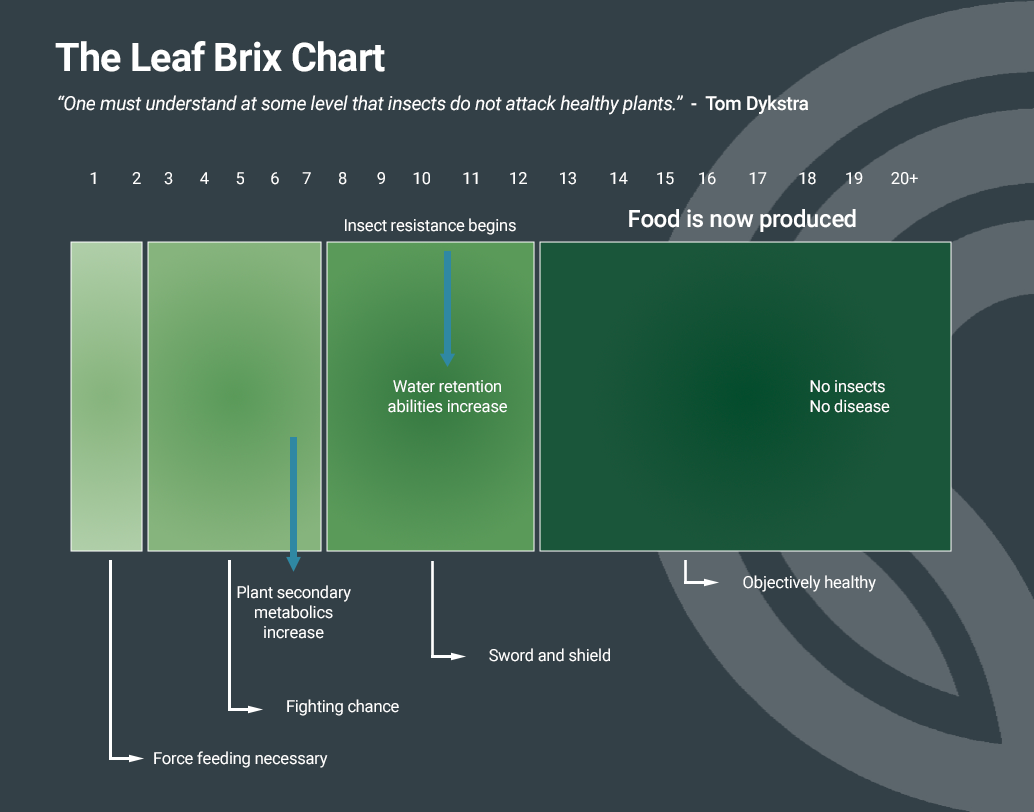
The Leaf Brix Chart
The Leaf Brix Chart, developed by dr. Thomas Dykstra, links Brix levels to plant performance. The chart shows how increasing Brix correlates with improved resistance, reduced pest pressure and better overall plant function. It also supports a key insight often shared in plant health discussions:
“Insects do not attack healthy plants.”
However, the chart also raises important practical questions.
Why Brix is not a simple number
Growers quickly discover that Brix is not a universal target:
- Optimal Brix levels differ per crop
- Growth stage matters
- Climate, light, and nutrition all influence Brix
- Microbial activity plays a crucial role
Brix should therefore never be used as a standalone KPI. A high number without context can be just as misleading as a low number without understanding the cause. What makes Brix powerful is not the number itself, but the trend and the story behind it.
From measurement to understanding
Brix measurements help growers move from reacting to symptoms towards understanding plant processes. They invite better questions:
- Is photosynthesis limiting the system?
- Is nutrient uptake restricted by transpiration or root activity?
- Is the plant feeding its microbial partners sufficiently?
Answering those questions requires more than a chart. It requires a system-level view.
Making plant health practical
At Plant Empowerment, we see Brix as one of several tools to better understand plant health. That is why Brix is embedded in the broader framework of the Plant Health Circle, where climate, nutrition, rootzone, pests and plant physiology are always considered together.
Through the year program Mastering the dynamics of your plant, we guide growers step by step through this complexity, translating measurements into practical, applicable insights. Not by simplifying reality, but by learning how to work with it.