

Plant health is often discussed in terms of problems: pests, diseases, deficiencies, stress. But what if those problems are not the starting point, but the outcome? That’s exactly the perspective behind the Plant Health Pyramid, developed by John Kempf. Rather than focusing on what goes wrong at the top of the crop, the pyramid helps growers understand why those problems appear in the first place.
From symptoms to system resilience
Understanding the Plant Health Pyramid
Published: December 20, 2025
Share?
What is the Plant Health Pyramid?
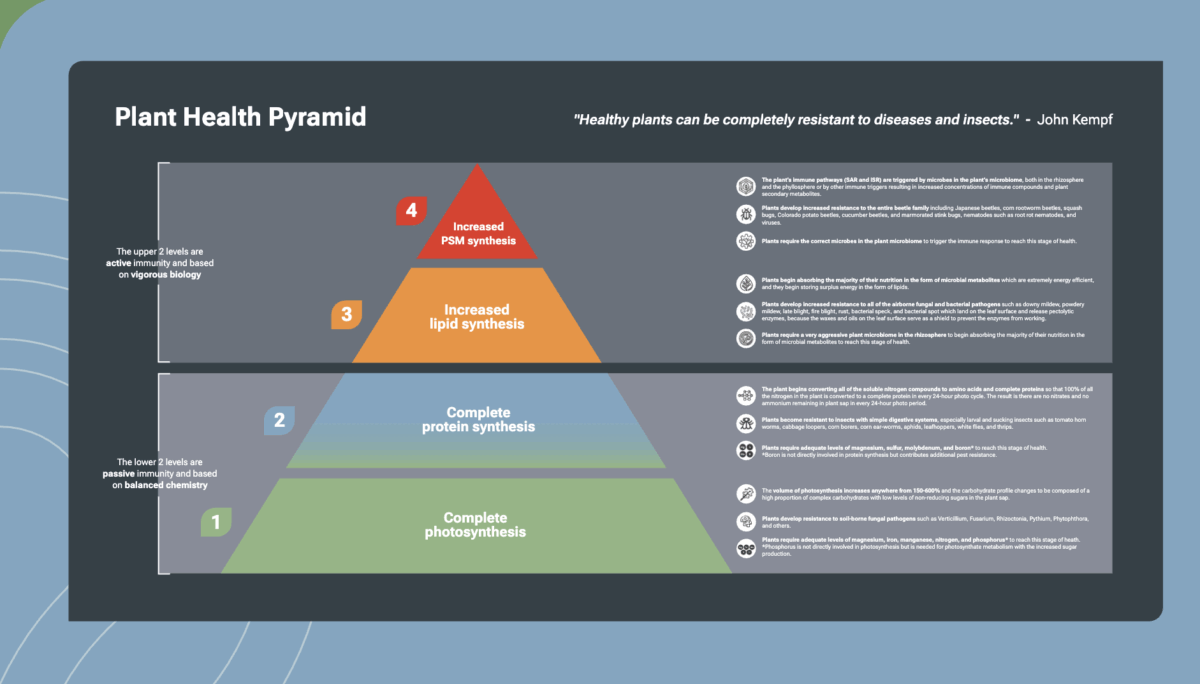
The Plant Health Pyramid shows how plant health is built step by step, from the inside out.
At the base of the pyramid lies photosynthesis and energy availability. Without sufficient energy, a plant simply cannot support growth, defense or recovery. As we move upward, the pyramid includes:
- Mineral balance and nutrient availability
- Protein synthesis and enzyme activity
- Complex sugars and structural compounds
- Secondary metabolites and plant defenses
Only at the very top do we encounter pests and diseases. This structure makes one thing very clear:
pests and diseases are not the root cause, but a signal that something lower in the pyramid is out of balance.
Why symptoms are misleading
In daily practice, growers often act at the top of the pyramid. A pest appears, a disease spreads, and action is taken immediately. While this can be necessary in the short term, it rarely solves the underlying issue.
According to the Plant Health Pyramid, true resilience is created much earlier in the process. When a plant has enough energy, balanced nutrition and well-functioning metabolism, it can produce the compounds it needs to protect itself. In such cases, pests may still be present, but they fail to thrive.
This explains why highly productive crops can also be the most resilient ones. Plant health and yield are not opposites; they are closely connected.
From theory to greenhouse reality
The challenge with the Plant Health Pyramid is not understanding the model, but applying it in practice.
Questions growers often ask include:
- How do I know where my crop is in the pyramid?
- Which signals tell me that energy or metabolism is limited?
- How do climate, nutrition, water management and biology interact in this system?
These are valid questions. The pyramid does not offer a checklist or a quick fix. Instead, it requires system thinking and a deeper understanding of how plant processes are connected.
Connecting the pyramid to the Plant Health Circle
At Plant Empowerment, we use the Plant Health Pyramid as an important foundation. It aligns closely with our Plant Health Circle, where we connect the plant, its growing conditions and the pressures around it into one coherent framework.
That’s why we developed the year program Mastering the dynamics of your plant. In this program, we translate concepts like the Plant Health Pyramid into practical greenhouse insights. Step by step, module by module, together with growers from all over the world.
Not to promise miracle solutions. But to help growers understand their plants better, make better decisions, and build true resilience over time.