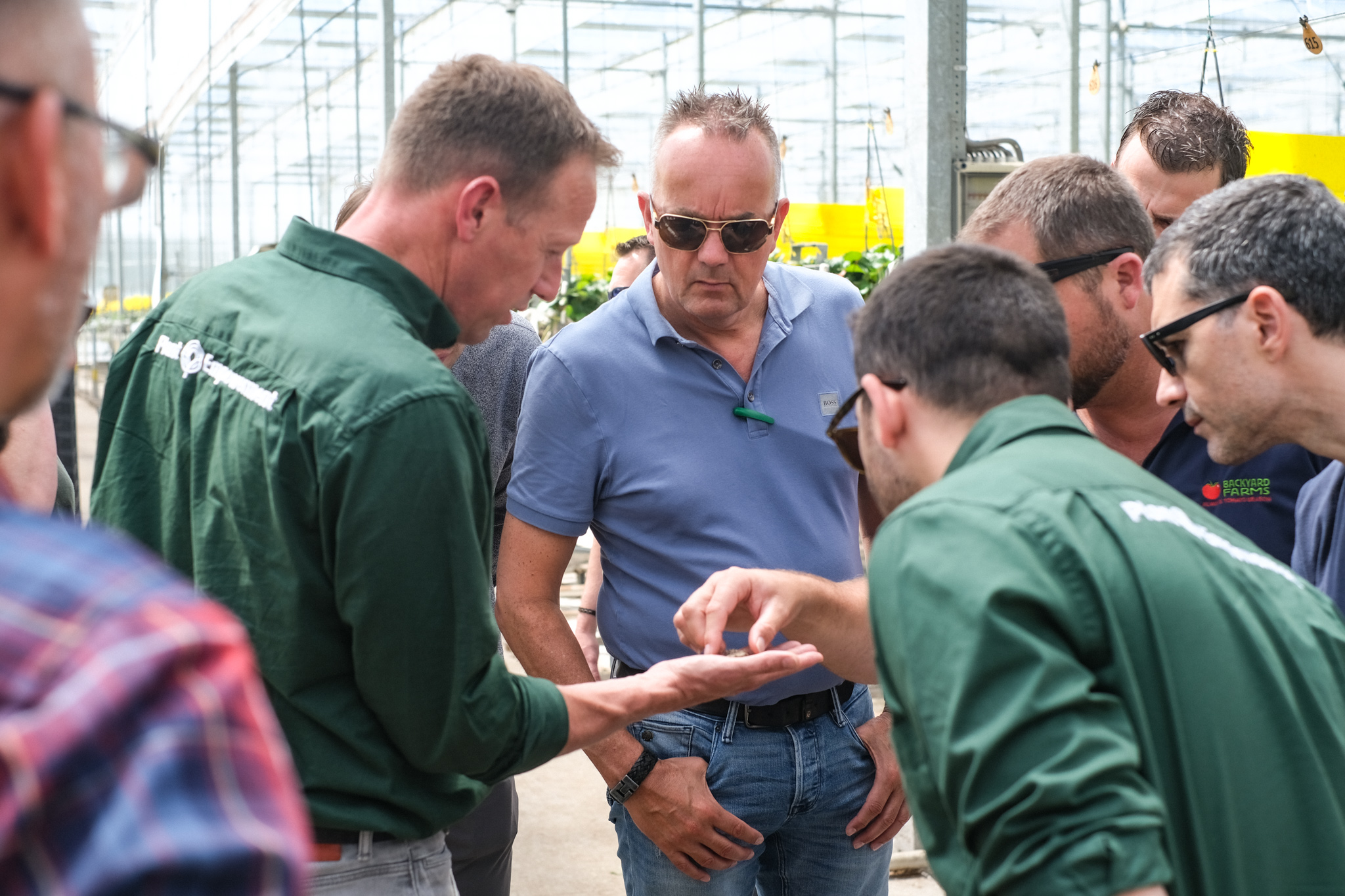
Brix is often associated with sugar content, but the measurement can offer a different perspective on plant health. During a recent knowledge session, Plant Empowerment consultants discussed Brix, greenhouse cultivation and plant resilience with Dr. Thomas Dykstra, who has been working with Brix measurements since the 1990s.
Insights from Dr. Thomas Dykstra
What can Brix tell us about plant health?
Looking beyond a single Brix number
For Dykstra, the value of Brix lies less in a single measurement and more in the changes that occur over time. Leaf Brix generally increases as a plant develops through its vegetative phase and can drop when the plant enters reproduction. At that point, more assimilates are directed towards flowers and fruit, increasing the demand on the plant.
This is particularly relevant for greenhouse crops that are continuously producing. A high plant load means a greater demand for assimilates, while a plant with limited reserves may become more susceptible to stress. Repeated Brix measurements can therefore help growers identify changes in the plant and relate them to what is happening in the crop.
Dykstra recommends measuring fully developed middle leaves and taking samples from multiple plants rather than relying on a single leaf. He typically measures between 1 and 5 pm and uses 30 leaves to obtain a representative value. For him, measuring several times per week is more useful than taking one measurement and treating it as a definitive answer.
Why are Brix levels often lower in greenhouses?
One of the most interesting parts of the discussion was the difference Dykstra sees between greenhouse and outdoor crops. He observes that greenhouse crops often have much lower leaf Brix levels than plants grown outside, and points to the limited amount of UV radiation reaching greenhouse crops as one possible explanation.
Greenhouse coverings, screens and coatings can reduce UV exposure considerably. Dykstra’s experience suggests that providing additional UV can increase Brix levels, although the required dose still needs to be better understood. This is an area Plant Empowerment is interested in exploring further. With real-time spectrometers now available, it is becoming possible to measure UV exposure alongside plant responses rather than simply assuming how much UV reaches the crop.
The discussion also connected this with CO₂ availability. In a well-sealed greenhouse, CO₂ can fall quickly when photosynthesis is active. At the same time, microbial activity in greenhouse substrates can be very different from that in outdoor soil. Both factors raise questions about how the controlled greenhouse environment affects plant health and Brix.
Brix is not the same as sugar in plant sap
Another important distinction was made between leaf Brix and sugar measurements from plant sap analysis. Although both measurements involve sugars, they should not automatically be interpreted in the same way.
Leaf Brix reflects the soluble solids in the leaf, including sugars that are stored there. Plant sap analysis provides information about what is moving through the plant at the moment of sampling. According to Dykstra, confusing these two measurements can therefore lead to the wrong conclusions about plant health.
This is a good example of why plant measurements need to be interpreted in context. A number only becomes useful when we understand what it represents and how it relates to the plant’s physiology.
From measurement to plant understanding
The discussion around Brix ultimately goes beyond the refractometer. Light, CO₂, nutrition, plant load, microbial activity and plant development all influence how a plant uses and stores assimilates.
For Plant Empowerment, that broader perspective is essential. The Plant Health Circle is based on the idea that plant health cannot be understood by looking at individual parameters in isolation. Measurements such as Brix can provide another piece of the puzzle, helping growers observe how the plant responds as growing conditions change.
The session with Dr. Thomas Dykstra was therefore not about finding one number that defines a healthy plant. It was about asking better questions about what is happening inside the crop, and how growers can use measurements to understand those processes.


Want to measure Brix yourself?
Understanding what a Brix measurement tells you is one thing. Knowing how to take a reliable measurement is another. In this practical article, we explain how to measure Brix in a plant and what to consider when taking samples.
Read the articleContinue reading
Training the next generation of tomato crop managers
Open: Training the next generation of tomato crop managers
Successful fifth edition of the Plant Empowerment Summer School
Open: Successful fifth edition of the Plant Empowerment Summer School