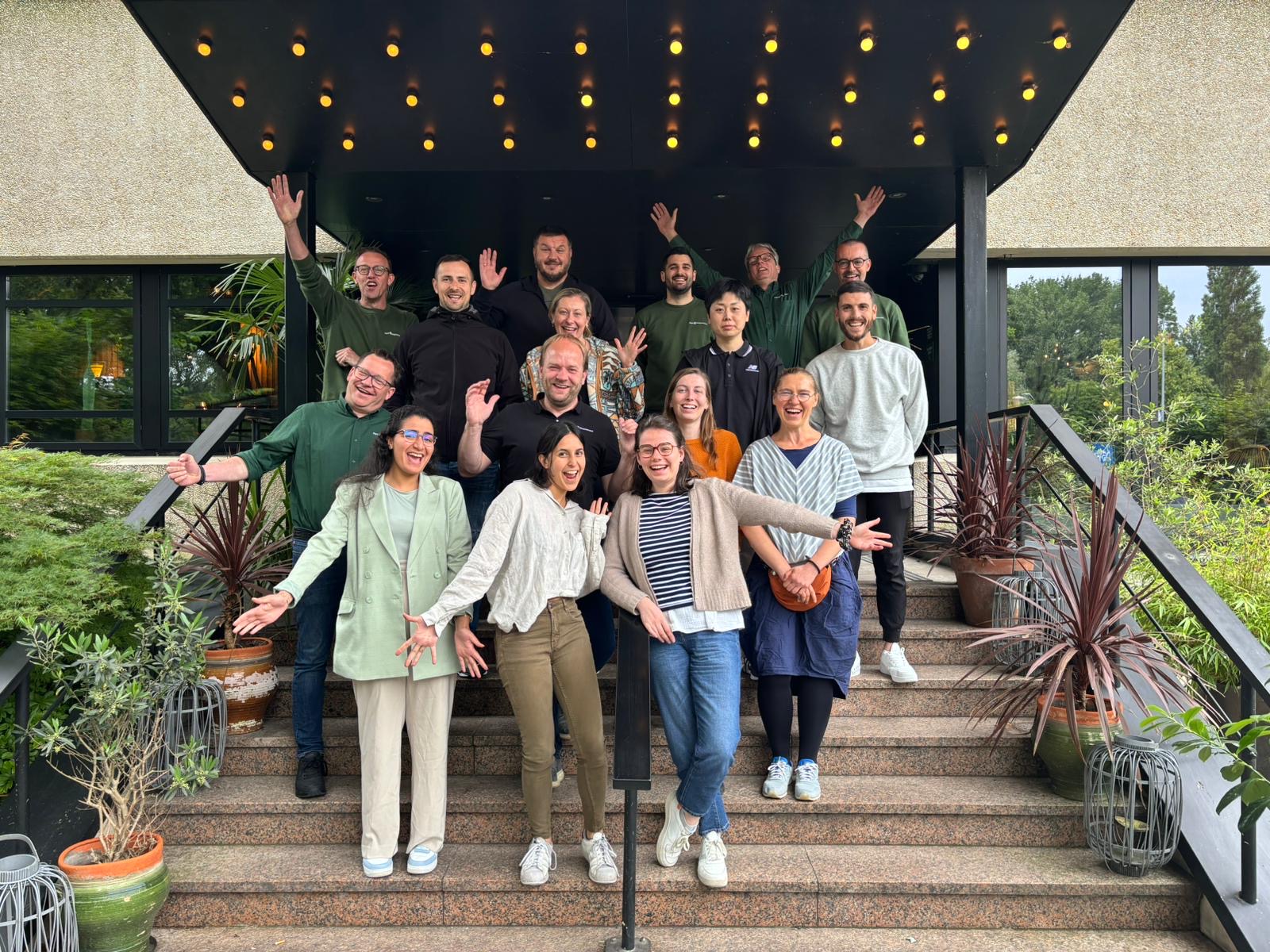
Pieter van den Berg, senior operational grower at Nature Fresh Farms in Leamington, Ontario, Canada, is utilising the Plant Empowerment principles to help him achieve his ambitious goal of eliminating chemical usage in his cucumber crops.
User Story
Nature Fresh Farms
Growing beyond borders – from the Lowlands to Leamington
Today, van den Berg grows long English cucumbers, as well as mini and cocktail cucumbers, for Nature Fresh Farms in Canada. Growing cucumbers is certainly a challenge, notes the grower, as they are a remarkably sensitive crop compared to others, like tomatoes. Furthermore, the Leamington region presents tough climatic conditions, characterised by extremely hot summers with high day and night temperatures, along with periods of severe humidity.
To build healthier, more resilient plants that can naturally resist disease, Van den Berg has keenly introduced biostimulants into the crop – a technique he has seen widely adopted in the Netherlands.
Dutch by birth, Van den Berg began his horticulture career in Holland when he was just 15 years old, taking a part-time nursery job to earn some pocket money while still in school. The grower recalls: “I would pack my clothes in my school bag so that I could head straight to the nursery the moment classes finished.”
Learning the trade, one crop at a time
Arguably, van den Berg’s career success highlights the value of both learning on the job and accumulating knowledge over the decades. Rather than going to university to study horticulture or a related subject, van den Berg learned directly on the job – working at the nursery Johan Smits from the age of 15 to 21.
Transitioning into vegetable crops, van den Berg was, for ten years, a pepper grower in a commercial glasshouse named Moors, before he moved to the tomato greenhouse, Gerard Koolen. Following this, he worked for van Gogh, a grower producing tomatoes, cucumbers, and strawberries where he was eventually responsible for managing the entire crop cycle.
After gaining several decades of valuable experience, van den Berg reached a pivotal moment in his career when he spotted an advert in LinkedIn for a grower position at Great Northern Soft Fruit Company. He says: “My wife and I had always talked about spending some time abroad – making this the perfect opportunity to cross the Atlantic and relocate from the Netherlands to Canada.”
The high energy prices in the Netherlands provided another key motivation for moving abroad, as commercial growing in Europe had become increasingly stressful. Van den Berg spent 18 months at Great Northern Soft Fruit Company before transitioning into his current role at Nature Fresh Farms.
Overcoming the sensitivity of cucumbers using the Plant Empowerment principles
Happily, the introduction of biostimulants into the cucumber crop at Nature Fresh Farms has proven to be a resounding success – enabling van den Berg to avoid spraying conventional crop protection chemicals for mildew control for 20 consecutive weeks.
“What we are seeing is that mildew is not an issue anymore,” he says, proudly. While the grower is unable, for commercial reasons, to reveal the exact proprietary products he uses to gain such remarkable mildew protection, he reveals that silicon plays a key role.
Because silicates are immobile within plant tissue, their uptake relies entirely on transpiration. By applying Plant Empowerment principles and techniques – such as using climate screens to maintain a steady transpiration stream and encouraging slightly more activity at night – he ensures the silicates are taken up effectively and transported to the area of the plant where they are needed most.
Van den Berg has been a keen practitioner of the Plant Empowerment philosophy since its inception – and his drive to produce healthy, resilient crops inspired him to sign up to the Plant Empowerment online series dedicated to plant health.
As he puts it: “I’m always trying to improve my knowledge of crop production. If there’s nothing left to improve anymore, then it’s getting too boring for me and I have to do something else!”
Reading the plant, day and night
Van den Berg’s learnings from the Plant Empowerment team inspired him to place advanced sensors and cameras amidst the cucumber plants – positioning them approximately one metre above the canopy. These devices allow him to see “exactly what the plant is doing – day and night,” monitoring leaf temperature and humidity to navigate the delicate physiological balancing act between photosynthesis (energy gain) and respiration/maintenance (energy loss) when using supplementary lights/LEDs.
Describing this balance in action, van den Berg explains: “After a few ‘dark’ days, the plant loses a bit of energy. If, for example, these dark days are followed by a very sunny day, the cucumber plants struggle to cope with the change because they are pretty sensitive. So, you then have to close your screen, or put the misting system on again, to allow the plants to slowly become accustomed to the sun again.”
Managing energy intake also means matching the fruit load to Daily Light Integral (DLI_ forecasts. “We look at the forecast, see what’s coming, and from there we make a pruning strategy.”
Combining traditional crop observations with modern data-gathering techniques, van den Berg’s data-driven approach is yielding exceptional results: last year, he harvested 365 long English cucumbers per square metre, with a goal of 400+ this year. “We are very close to reaching the maximum our greenhouse can produce,” says Pieter, proudly.
The road to zero chemicals
Van den Berg deepened his expertise in sustainable crop production by attending the Plant Empowerment Summer School in June 2026. Despite his extensive background and decades of experience, he returned with more than a dozen actionable insights to apply to his greenhouse setup which, he says, “is pretty great.”
During the summer school, van den Berg, his fellow growers, and the Plant Empowerment consultants talked a lot about plant health which, he states, “is still a bit of a grey area, and I think there’s still a lot to learn in relation to which products you have to use and when.”
Van den Berg is continuing to test a wide variety of biostimulants – including seaweed-, Bacillus-, and Trichoderma-based products – to determine precisely when in the crop it is best to apply which product.
Less spraying, healthier plants
In the near future, the grower aims to use zero synthetic crop protection chemicals on his crop. He does not believe in preventative sprays when the pest or disease is not present in the crop – preferring instead to boost the plant’s natural defences in advance.
Incredibly, van den Berg has successfully reduced synthetic crop protection chemical applications on his crop by 70% in the past year – all thanks to data-driven growing, following the Plant Empowerment principles.
Van den Berg concludes: “My goal is to have zero chemicals, use less energy and more cameras, and gain a better overview of the greenhouse. It’s all about fine-tuning.”
Interested in the Summer School?
Other user stories
A greenhouse trial that increased production by 12%
Open: A greenhouse trial that increased production by 12%
Growing potted Hellebores in extreme heat: A data-driven approach
Open: Growing potted Hellebores in extreme heat: A data-driven approach
Always learning something extra about Plant Empowerment in open field crops
Open: Always learning something extra about Plant Empowerment in open field crops
From old school to High-Tech: How João Constantino revolutionized medicinal growing with Plant Empowerment
Open: From old school to High-Tech: How João Constantino revolutionized medicinal growing with Plant Empowerment
Doubling strawberry production two years in a row with Plant Empowerment
Open: Doubling strawberry production two years in a row with Plant Empowerment
From inspiration to implementation: the value of the Plant Empowerment knowledge platform
Open: From inspiration to implementation: the value of the Plant Empowerment knowledge platform
Improving tomato growth and reduces chemical use
Open: Improving tomato growth and reduces chemical use
Data-driven growing keeps growers ahead of the curve
Open: Data-driven growing keeps growers ahead of the curve