Growing ornamental crops comes with specific challenges. Differences in crop structure, light distribution and plant temperature can influence flower development and quality. Understanding how these factors affect plant responses helps growers make better decisions in the greenhouse.
Improving flower quality in floriculture
Every ornamental crop has its own challenges
A Gerbera grower faces different challenges from someone growing Kalanchoë, Hydrangea or Phalaenopsis. The crops differ in structure, leaf density and growing patterns, and so do the conditions they need.
Many ornamental crops have compact structures, overlapping leaves or growing points located deep inside the plant, sometimes close to the substrate. This can create local differences in temperature and humidity. Moisture may build up between the leaves, while the growing point or flower experiences very different conditions from the surrounding greenhouse air.
The growing system matters too. Crops grown on tables or heated floors have a different environment around their roots and lower leaves than crops grown in other systems. This is one reason why climate strategies from high-wire vegetable production cannot simply be applied to floriculture.
LED lighting and the plant’s energy balance
The transition from HPS to LED lighting has brought new opportunities for floriculture growers. But replacing HPS with LED is not simply a matter of changing the lamps and keeping the same climate settings.
To understand why, it helps to look at the energy exchange between a plant and its surroundings. These energy flows, known as energy fluxes, include radiation, convection, transpiration and heat emission. Together, they influence the plant’s energy balance and temperature.
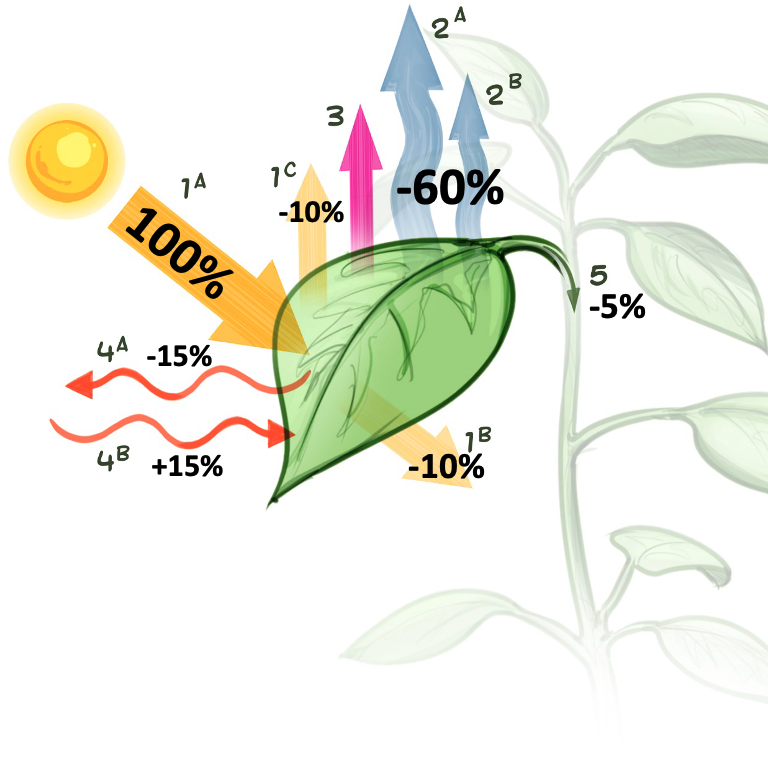
The different energy flows that influence a plant’s energy balance at leaf level.
One important difference between HPS and LED is radiant heat. HPS lamps provide more radiant heat to the crop, while LED fixtures generally provide less. Even at similar light levels, this can affect plant temperature and transpiration.
In Gerbera, for example, growers may see more flowers under LED, but development can take longer. Air movement within a dense crop can help support transpiration and prevent excessive humidity build-up. This can be a more energy-efficient approach than simply increasing pipe temperatures.
Light distribution matters
Ornamental crops do not all tolerate the same amount of radiation. A plant that has experienced several cloudy weeks may react differently to a sudden period of strong sunlight than one that has gradually adapted to higher light levels.
The type of light also matters. Direct sunlight can create large differences between the upper and lower parts of a crop. Leaves exposed to direct radiation receive more energy, while leaves deeper inside the plant receive considerably less. Diffuse light helps distribute radiation more evenly throughout the crop.
For growers, the goal is not simply to achieve a high light level, but to make the best possible use of the available light without exposing sensitive crops to excessive radiation.
Flower temperature and the root zone
In floriculture, the temperature of the flower itself can be just as important as the temperature of the greenhouse air. Gerbera flowers, for example, can lose heat through radiation, particularly during the evening and night. Their temperature can drop even when the greenhouse air temperature appears to be under control. This can increase the risk of condensation and Botrytis.
Climate screens can help limit heat loss and maintain flower temperature. However, their effect depends on the crop structure and the position of the flower and growing point.
The root zone deserves attention as well. Heated floors and accumulated heat in the greenhouse floor can influence pot and root temperatures. In Hydrangea, for example, a warm root zone can affect plant growth and cell elongation.
Explore Plant Responses in Floriculture
How does LED lighting affect Gerbera? Why can humidity build up inside a dense crop? And what role do light, temperature and root-zone conditions play in flower development and plant length?
In the course Plant Responses in Floriculture, René Beerkens and Peter van Weel explore these questions through practical examples from ornamental crop production, helping growers better understand what happens inside their crops and how to respond.
Continue reading
Greenhouse microclimate: Why climate control isn’t enough
Open: Greenhouse microclimate: Why climate control isn’t enough
The Rhizophagy Cycle: What happens between roots and microbes?
Open: The Rhizophagy Cycle: What happens between roots and microbes?