Starch is an important energy reserve in plants, allowing them to store excess sugars and use them when needed. However, this storage mechanism is not without cost. Both the conversion of sugars into starch and the breakdown of starch back into usable sugars require energy. This two-way investment is part of the plant’s assimilate balance and helps the plant manage periods when assimilate production and demand are not in sync.
Sugar and starch metabolism in plants
The two-way energy cost of starch
Putting energy in the bank
Through photosynthesis, plants produce sugars (assimilates) using light, CO₂ and water. These sugars provide the energy and building blocks needed for growth, maintenance and development.
When sugar production exceeds the plant’s immediate needs, for example when light levels are high but temperatures are too low for sufficient growth and sugar consumption, the plant can convert excess sugars into starch. Starch acts as a temporary energy reserve, allowing the plant to store energy for periods when photosynthesis cannot meet its needs.
You could compare this to putting money into a bank account. The plant saves energy now so it can use it later.
But the bank charges twice
There is one important detail: storing and retrieving energy both require an investment.
Storing energy: Converting glucose into starch requires energy, including ATP.
Retrieving energy: When the plant needs that stored energy, starch must be broken down and converted back into sugars. This process also involves energy-consuming steps.
As Rene Beerkens, Climate Specialist, explains: “Putting it to the bank costs money. Taking it from the bank, I have to pay again.” In other words, the plant pays to store its energy and pays again to retrieve it. This makes starch storage a useful strategy, but one that comes with metabolic costs.
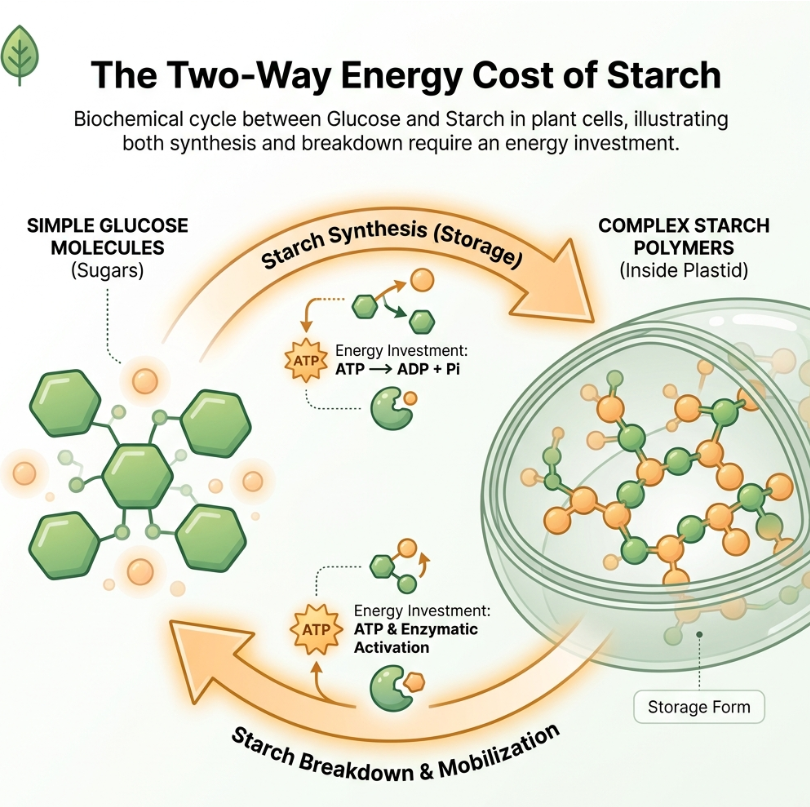
Both starch synthesis and starch breakdown require an energy investment. Storing sugars for later use therefore comes at a cost.
Keeping the balance
This is why maintaining a good assimilate balance is so important. Ideally, the plant produces sugars at a rate that matches its demand for growth, maintenance and development.
Temperature plays a key role in this balance. Higher temperatures generally increase respiration and energy consumption, while lower temperatures can slow down growth and the use of assimilates. If sugar production consistently exceeds demand, more energy may be stored as starch. If demand exceeds production, the plant needs to draw on its reserves.
A small energy reserve is valuable. It provides a buffer for changing conditions and supports plant resilience, including healthy root development. However, relying too heavily on storage means repeatedly paying the energy cost of converting sugars into starch and back again.
The goal is not to avoid the bank altogether, but to manage the balance wisely: maintain enough reserves for resilience while keeping sugar production and consumption in sync.
Connect the dots of plant growth
This article explores one part of the Plant Empowerment philosophy: the three balances within the plant. In the Plant Empowerment Basic Course, you’ll discover how the assimilate, energy and moisture balances work together to drive plant growth and development, and how to apply these principles in practice.
Continue reading

Greenhouse microclimate: Why climate control isn’t enough
Open: Greenhouse microclimate: Why climate control isn’t enough
The Rhizophagy Cycle: What happens between roots and microbes?
Open: The Rhizophagy Cycle: What happens between roots and microbes?