Every morning, greenhouse growers see the same thing: as the sun rises, relative humidity starts to drop. At first glance, it looks like the greenhouse is drying out. But according to the Plant Empowerment philosophy, this can be a misleading conclusion.
Understanding absolute humidity in greenhouse climate control
The difference between RH and AH
While relative humidity decreases, the actual amount of water in the air, known as absolute humidity, is often increasing rapidly as plants become active and start to transpire. Understanding this difference is key to making better climate decisions and creating a healthier, more active and resilient crop.
If you are steering your greenhouse humidity based solely on percentages, you are looking at a moving target. Plant Empowerment focuses on the greenhouse moisture balance by prioritizing Absolute Humidity (AH) over Relative Humidity (RH). Here’s why this approach leads to better climate decisions.
The humidity illusion: Why RH can be misleading
To master greenhouse humidity control, you first have to understand the physics of air. Relative humidity is exactly what the name implies: relative. It describes how much water vapor is in the air compared to the maximum amount that air could hold at its current temperature.
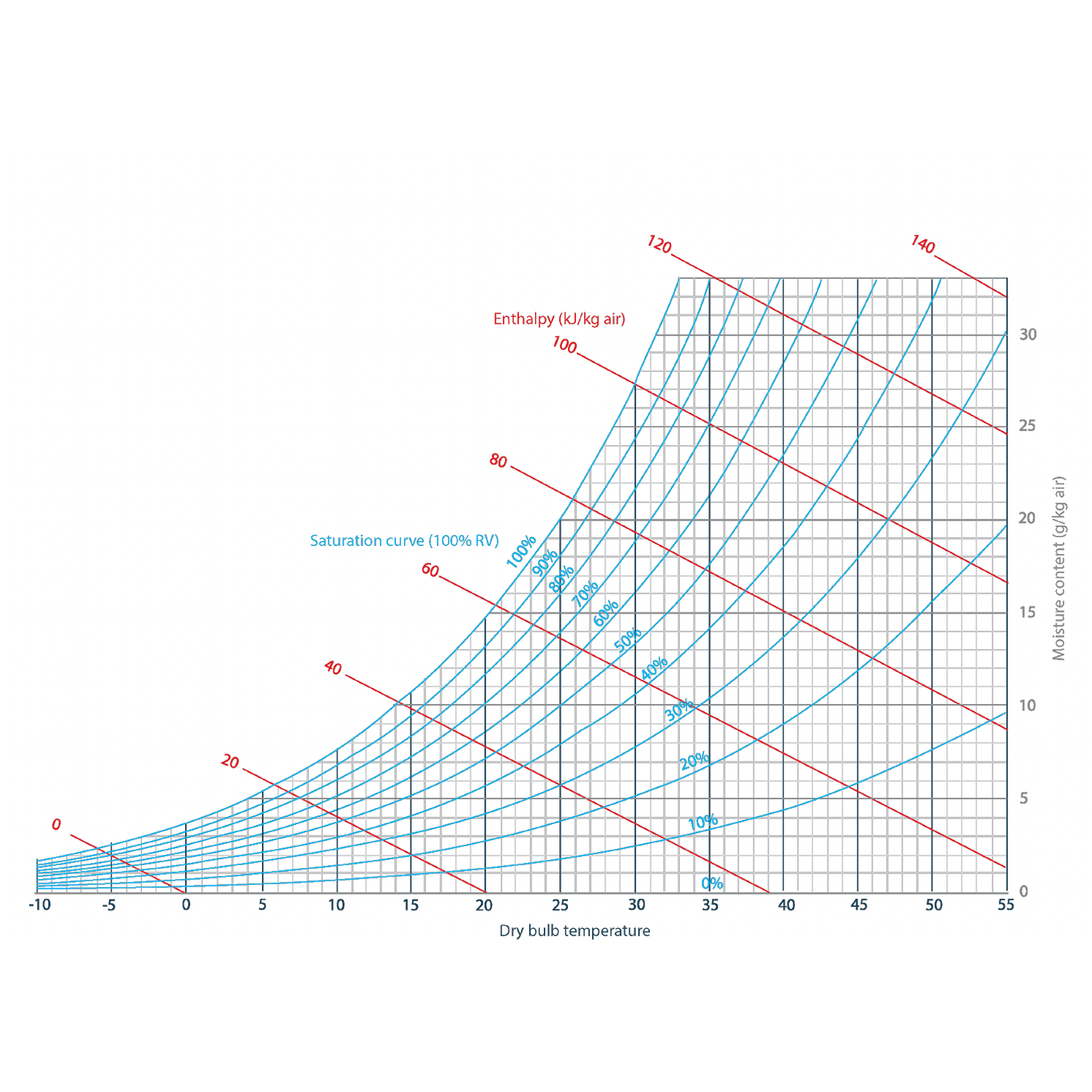
As the air temperature rises, its capacity to hold water increases. This means that if you have a fixed amount of water in a room and you turn up the heat, your RH percentage will drop even though not a single drop of water has left the room.
For example, air containing the same amount of moisture may measure 40% relative humidity at 29°C, but 100% relative humidity at 15°C. The amount of water hasn’t changed, only the air’s capacity to hold it has.
By focusing on absolute humidity rather than relative humidity, growers gain a much more reliable understanding of the greenhouse moisture balance, regardless of temperature fluctuations.
The physics of diffusion: The “Tea Bag” principle
Why does it matter how much moisture is actually in the air? It all comes down to plant transpiration. Water vapor leaves the leaf through diffusion, moving from a high concentration near the leaf surface to a lower concentration in the surrounding air.
Think of a tea bag in a cup of hot water. Without any movement, the tea diffuses slowly. But if you stir the water, the diffusion happens much faster. In a greenhouse, the plant is the “tea bag” and the air is the water. If the absolute humidity greenhouse levels are too high, the concentration difference between the inside of the leaf and the surrounding air is too small. The “tea” stops moving.
When plant transpiration stalls, the plant loses its ability to cool itself and, more importantly, its ability to transport nutrients like calcium and potassium to the growing tips. This is why even in a greenhouse with “perfect” RH, you can still see deficiencies or fungal outbreaks if the greenhouse moisture balance is off.
The Microclimate: Where the real battle happens
The real climate isn’t measured by your greenhouse sensors, but at the leaf surface. Here, a thin layer of stagnant, humid air, known as the boundary layer, influences how effectively the plant can transpire and exchange gases with its environment.
Your aspirated sensor box might be hanging 25 centimeters away from the crop, showing an RH of 85%. However, inside that boundary layer, the humidity could be near 100%, creating a perfect breeding ground for fungi. To break this layer, you need energy.
Traditionally, growers used “minimum pipe” heating to create a slow, vertical airflow through the crop. While effective, this is energy-intensive. Modern greenhouse climate control now favors vertical fans that use as little as 1 watt per square meter to achieve the same effect that 40 watts of pipe heat would provide. This mechanical “stirring” of the air ensures that the absolute humidity greenhouse levels at the leaf surface are constantly being refreshed, allowing the plant to breathe and grow efficiently.
Steering on trends, not just values
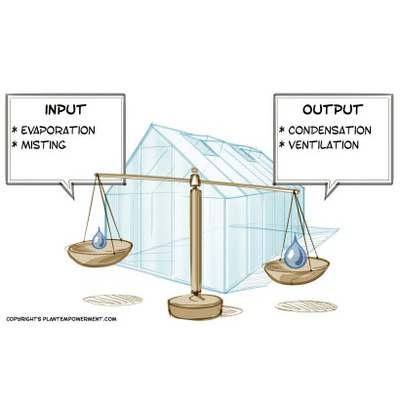
Rather than steering on a fixed absolute humidity value, Plant Empowerment recommends monitoring the trend. The direction of the AH graph reveals whether your greenhouse moisture balance is moving in the right direction
- Rising trend: Moisture production (transpiration) exceeds moisture removal. Humidity is accumulating in the greenhouse.
- Falling trend: Moisture removal through ventilation or condensation exceeds moisture production.
- Stable trend: Moisture production and removal are in balance.
Monitoring these trends allows growers to respond proactively instead of reacting after problems occur. For example, a rapidly rising AH trend during the afternoon may indicate that additional ventilation or climate adjustments are needed before evening conditions increase the risk of condensation.
Absolute humidity tells you what is happening in the greenhouse. The next question is: what is the plant actually experiencing? This is where VPD comes in.
VPD: The next level of precision
While absolute humidity helps you understand the greenhouse environment, VPD (Vapor Pressure Deficit) helps you understand how the plant responds to those conditions. Plant Empowerment takes this one step further by focusing on Vapor Pressure Difference, which also considers the leaf temperature.
Unlike the conventional VPD calculation, Vapor Pressure Difference compares the vapor pressure inside the leaf with the vapor pressure of the surrounding air. If the difference is too low (below 0.2 kPa), transpiration slows down and the plant becomes less active. If the difference is too high (above 2.0 kPa), the stomata begin to close to reduce water loss, limiting transpiration and plant activity.
Together, absolute humidity and Vapor Pressure Difference provide a more complete understanding of both the greenhouse climate and the plant’s response.
Taking control of your greenhouse moisture balance
Transitioning from RH to AH steering is a fundamental shift in how you perceive your greenhouse. It moves you away from reacting to “damp air” and toward managing a physical balance of energy and water.
But understanding the “why” is only the beginning. To truly implement these principles, you must learn to navigate the psychrometric chart (psychro diagram): the “map” of greenhouse physics. You need to know how to use climate screens not just for heat retention, but as a tool for controlled humidity discharge.
Are you ready to stop guessing and start steering? The physics of greenhouse climate control are constant, but the way you apply them makes the difference between a surviving crop and a thriving one.
This article introduces the basics. Explore the Do’s and Don’ts in Absolute Humidity course for a deeper understanding and practical applications.
Continue reading

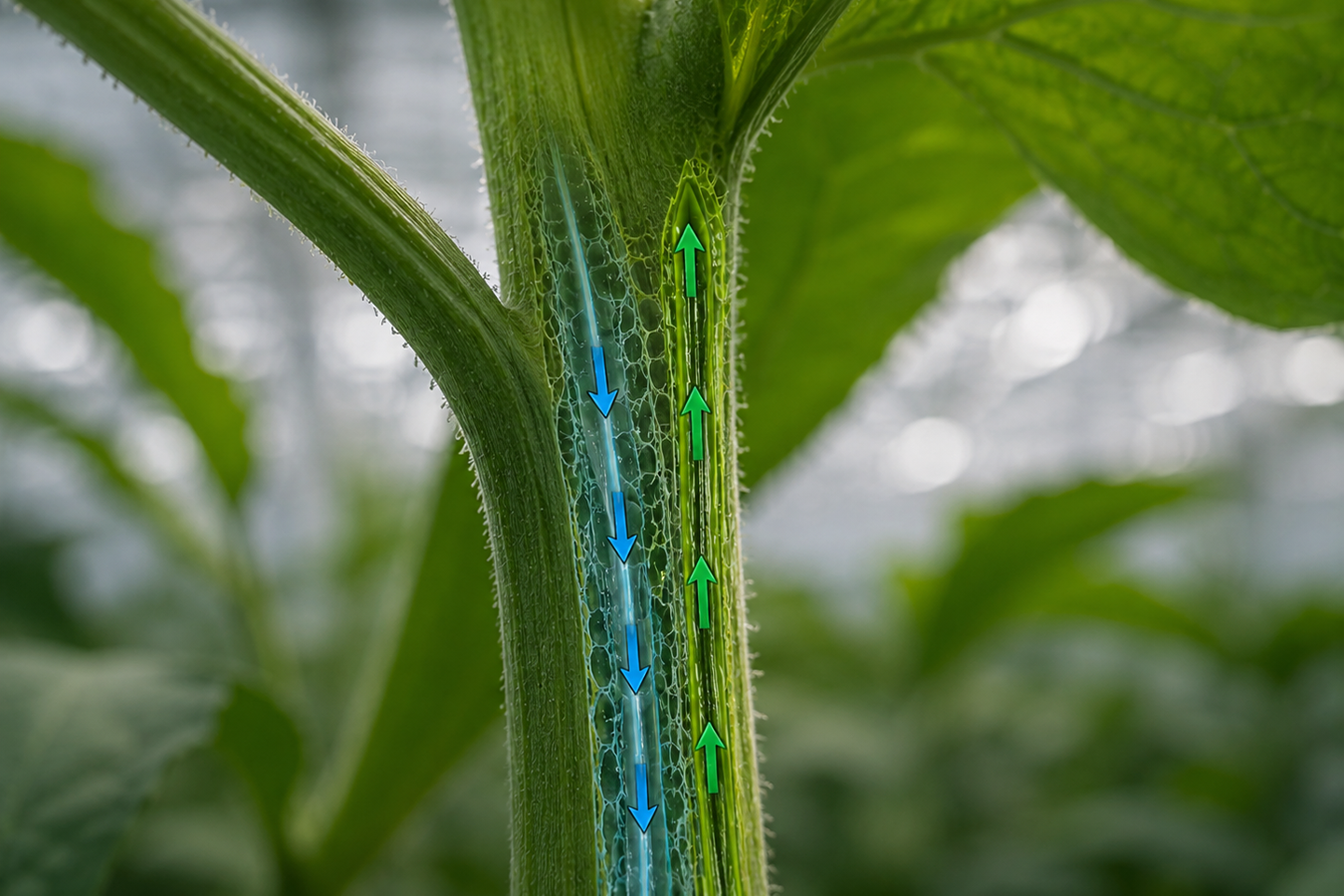
How plants transport water, minerals and sugars
Open: How plants transport water, minerals and sugars